Showing posts with label mao. Show all posts

2008-09-06

After Mao

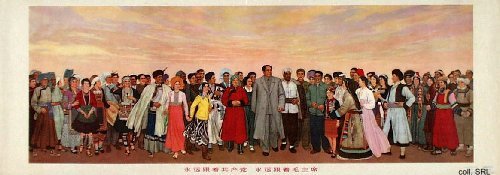
When Mao Zedong died on 9 September 1976, the country was in shock. This was partly the result of the keenly felt loss of a semi-divine leader, but also caused by the enormous uncertainty about what the future held in stock for China and its people. The power struggle between Jiang Qing and the Gang of Four on the one hand, and Mao's designated successor Hua Guofeng on the other, which had been smoldering for some time, was about to be fought out in public. Some of this uncertainty is visible in the tenseness of the faces of the persons in the poster below. However, on 6 October 1976, within a month after Mao's death, Hua had the Gang of Four arrested. This bold move was supported by various old Party cadres and Army men, including Ye Jianying, Li Xiannian, Xu Xiangqian and Nie Rongzhen.


Two days after the arrest of the Gang, the highest organs of the party and the state decided that a Memorial Hall would be built as a permanent tribute to the founder of the People's Republic. On 24 November 1976, the foundation stone for the gigantic building, located to the south of the Monument to the People's Heroes on Tian'anmen Square, was put in place. Both Hua and Ye, the strong men of the immediate post-Mao era, were prominently present at the ceremony.


The construction went on day and night, and the building was finished on 29 August 1977. On that same day, Mao's body, which had been embalmed and placed in a crystal sarcophagus, was moved to the Hall. On 9 September 1977, a ceremony was held to commemorate the anniversary of Mao's death and the completion of the Hall.


In December 1983, four memorial rooms were added to the Memorial Hall, which serve as reception rooms for important guests. Aside from the one to the left of the entrance hall, which is dedicated to Mao, the others are dedicated to his former colleagues of the First Generation of leaders, Zhou Enlai, Liu Shaoqi and Zhu De. For many artists and designers, contributing works to the Hall is seen as a mark of distinction, proof of them being in tune with the national mood. One of these contributing artists is Liu Yuyi, known for his huge canvasses that commemorate landmarks in recent Chinese (and world) history.


Although the Hall is open to the general public, it tends to be closed for maintenance purposes for extended periods of time. For precisely these reasons, the Hall was closed in the Summer of 2007 in preparation for the Olympic Games of 2008. It is unclear whether this maintenance is needed for the upkeep of the building, or for Mao's remains. Nonetheless, the Hall still draws large crowds of visitors, many of whom lay flowers at the foot of a marble statue of a sitting Mao, located in the northern entrance hall.

Mao Pop

Under the political clampdown after the Tian'anmen Incident (1989), many avant-garde artists felt hampered to express their socially critical side. Painting with a cynical attitude, they recycled images from propaganda posters and from the Cultural Revolution in their works. Mao Zedong became a frequent and favored subject of what came to be named Political Pop, or Mao Pop. The phenomenon echoed the sudden enthusiasm for Mao relics and Cultural Revolution songs (set to a discobeat) in Chinese society.


The image above, The Last Banquet (laser prints, pages of the Red Book and acrylic on canvas, 1989), is one of my favorite examples of Mao Pop. It is not a poster, and it is not in my possession. The artist, Zhang Hongtu, has graciously given me permission to use it in these pages. Many more samples of Hongtu's art (both Mao Pop, which includes the Mao Zedong acupuncture chart, and other works) can be found on his excellent webpage MoMao.

Mao in Silk

At the height of the cult surrounding him, Mao's image was reproduced on practically every medium imaginable. Porcelain, ivory, gypsum, rock, wood, leather, paper (both as papercut and as poster), embroidery, scrap metal, and even silk fabric bore images of the Chairman.


These silks reproduced well-known images of Mao and Party history. They were manufactured by the Hangzhou "East is Red" Silk Factory and could be framed or mounted as scrolls.


The veneration of Mao continues to the present day. In Reform China, his image is no longer woven into silk. Department stores still carry the Mao-brand, produced with the most advanced techniques on artificial fibres.

Sloganeering

The Mao cult involved a lot of sloganeering that served to bolster the myth surrounding the Chairman and to ascribe super-human qualities to him. During the first reception of millions of Red Guards on Tian'anmen Square on 18 August 1966, Chen Boda first used the slogan of the 'Four Greats', with which he termed Mao as the great teacher, the great leader, the great (or supreme) commander, and the great helmsman. The image of Mao as the great helmsman not only inspired poster designers, but gave birth to a song, "Sailing the seas depends on the helmsman, waging revolution depends on Mao Zedong Thought".


Other slogans revolved around the people's loyalty that Mao deserved. Particular mention must be made of the 'Three Loyalties', which called for boundless loyalty to Chairman Mao, loyalty to Mao Zedong Thought and loyalty to Chairman Mao's revolutionary line. The Chinese character for loyalty, zhong (忠, visible on the sunflower below), played an important role in the images devoted to these slogans.


These and other slogans ('The Four Boundlessness', 'Long Live ...', 'Eternal Life ...') were shouted in public by leaders and led alike, used in the print media and wall papers, and became part of everyday speech.

Chairman Mao's Mangoes

In August 1968, Mao Zedong received a delegation from Pakistan, headed by the foreign minister. At that occasion, he was presented with a basket of mangoes. According to some stories, Mao actually disliked mangoes, but the fruits were given an important and symbolic role in the complex political situation of the Cultural Revolution. For Mao did not eat the mangoes himself, but presented all seven of them to a corresponding number of Worker-Peasant Mao Zedong Thought Propaganda Teams that were active in the capital. These Teams had been sent to universities and factories to restore order and bring an end to the intense and bloody factional struggles between various groups of Red Guards. The media at the time reported that the gift was intended to mark the second anniversay of Mao's own big-character-poster Bombard all Headquarters. In reality, the mangoes served to indicate that Mao had become dissatisfied with the Red Guards, and henceforth would support the Teams. The Red Guards subsequently were sent to the countryside to learn from the Poor and Lower-Middle Peasants in the Up to the mountains, down to the villages-campaign.


The factories and universities that received the mangoes were overfilled with joy at this Great, Greatest, Happiest of Events. Many became obsessed with the question how to preserve the gift. In one case, the mango was put in a small glass box, engraved with an inscription and an image of Mao with rays of sunshine emanating from his head. The Beijing People's Printing Agency, on the other hand, decided to place the mango in a jar of formaldehyde, to preserve it for all eternity (according to later reports, this particular mango unfortunately turned black and shriveled). In still another case, the mango was put in a huge tank of water; all employees of the factory were given a small amount of that water to drink and to be literally filled with the spirit of Mao. Although the media had a field day, although pages were filled with mango mania and even posters were published, there is no mention anywhere of someone actually eating one of the fruits. After all, nobody would have been worthy of this privilege but Mao himself. But the fact of the gift itself was celebrated and commemorated.

Quotations from Chairman Mao

The Quotations from Chairman Mao, the Mao zhuxi yulu (毛主席语录), 426 in total, were culled from the numerous writings in which Mao had set out to sinify Marxism-Leninism over the years and which had been brought together in the four-volume Selected Works of Mao Zedong. Already in Yan'an, Mao was styling himself as the sole theoretician of Chinese communism, on a par with and later even superseding, Marx, Engels, Lenin and Stalin. As a result of Mao's (re-)interpretations of the Marxist Classics, his writings became known as Mao Zedong Thought. The Quotations were first published in 1961 for use in the People's Liberation Army under Lin Biao.


In the early 1960s, and during the first phase of the Cultural Revolution, the PLA played a major role in the popularization of the Quotations. According to Lin, "Everything that Mao Zedong says is the truth; every statement he utters is worth 10,000 sentences." The more wide-spread the study of the book, the more devastating the effects that were ascribed to it. In 1960, Mao Thought was seen as an arrow aimed at the target of revolution; by 1965, the Quotations were seen as a mighty "ideological weapon" in the struggle against imperialism, revisionism and dogmatism. One year later, Mao Thought had grown into a "spiritual atom bomb" of infinite power.


Although printed in staggering numbers (some 740 million by 1968), the "Little Red Book", as it became known in the West, was not the only medium through which Mao Zedong Thought was spread. The Renmin ribao (People's Daily), the mouthpiece of the Party, carried a daily changing Mao-quote printed in red in its masthead, to supplement the abundant number of quotes in boldface which peppered the articles. A number of quotes were reproduced on posters and these were given the place of honor wherever they were displayed.


Regularly, so-called Chairman Mao's Latest Instructions were published. These utterings of profound wisdom were to be welcomed with great fanfare, with gongs and cymbals. All work was stopped, and people were even told to get out and hail their arrival in the streets.


Only in the early 1980s, when the official, negative, verdict of the Cultural Revolution was formulated by the CCP, it was decided that the ideological repository originally attributed to Mao was—in reality—the crystallized wisdom of all the leaders of the Chinese revolution.