2008-04-10

National Minorities


The nationalities' policies as phrased in the Common Program of 1949, the provisional Constitution that predated the first Constitution promulgated in 1954, actually favored those groups that had a minority status। One result of this was that the first national census, which took place in 1953, reported no less than 400 minorities. In the period 1953-1956, all these groups that asserted a separate nationality status were determined by applying the definitions that Josef Stalin had defined as markers for nationality status. Thus, they had to share a common language, a common economic base, a common psychological makeup (or culture), and a common territory. As this was not always applicable in China, the markers of historical origin, migration history and agreement by the people themselves were added. By applying these definitions, 54 minorities had been officially recognized as such by 1957. Over the years, the identification work would continue. The last people to be recognized, the Jinou, was added in 1979.


It is important for an ethnic group to be officially recognized as a national minority. Minority peoples are given special treatment, including a license of moral, cultural, religious and social liberties which the state does not wish to grant to the majority of the population. These liberties include a family planning policy which does not restrict the number of children; the right to retain certain marriage patterns and traditions of conducting one's sexual life; and the right to engage in various forms of religious practices which are otherwise considered "superstitious"। On the political level, being a minority may lead to a level of limited autonomy that leaves room for local decisions on education, finances, culture and religion. It is also important for the state to officially recognize a national minority. It has set up an apparatus for registering and administrating ethnic differences, allotting different rights to different ethnic groups. This enables selective social control and formal structures for political inclusion or cooptation of groups which otherwise might alienate themselves from the system.


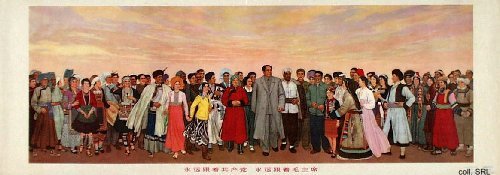
The cooptation of minority interests has been an important factor in forging national unity, in merging all 56 national individual minorities into one Chinese nation। Another element has been the presentation of the best and most pliable elements of nationality culture in terms of this unity. In the media, national dances, music and songs are woven together in a mixture which implies unity while at the same time emphasizing the individual characteristics of each nationality.


Although it can be said that these elements have saved certain minority practices from extinction, they at the same time have had a stiffling effect on the development of these peoples. The 'noble savages' in their colorful national costumes, fellow countrymen yet so alien, living in their traditional dwellings and compounds, engaging in traditional songs and dances, have become important components of a thriving tourist industry that caters to both foreign and Chinese visitors. Sadly enough, the minorities themselves usually are not sharing in the profits.

National मिनोरिटी


China is a multi-ethnic state. According to the census conducted on 1 November 2000, aside from the Han Chinese, which account for 91।6 percent of the population, there are 55 officially recognized ethnic minorities, or 'national minorities' in Chinese parlance (shaoshu minzu 少数民族), numbering some 106.4 million people all together. These minorities inhabit approximately 60 percent of Chinese territory, often in the strategically more important or sensitive areas along the borders. The largest minorities are the Zhuang (in Guangxi Zhuang Autonomous Region, 15 million); the Manzu, or Manchu (in Northeast China, 9.8 million); Moslems, or Hui (all over China, 8.6 million); Uygur, or Weiwu'er (in Xinjiang Province, 7.2 million); Tujia (Hunan Province, 5.7 million); Mongolians, or Meng (Inner Mongolia, 4.8 million); and Tibetans, or Zang (in Tibet, Qinghai and Sichuan, 4.6 million). The smallest national minorities number only a few thousand members, for example the Gaoshan (Fujian Province) and the Lhoba (Tibet). Many other different ethnic groups (as many as 350) seek official recognition, and at least 15 of them are reported to be officially considered for such recognition.

It is a longstanding myth in China that all peoples inhabiting the territory form a homogeneous whole, the Zhonghua minzu 中华民族, or Chinese nationality। This myth is based upon the premise of a shared descent from the mythological Yellow Emperor, the foundation figure of all Chinese who was purportedly born in 2704 BCE. This legend in turn forms the basis for a (racial) nationalism that implies the existence of primal biological and cultural bonds among China’s various ethnic groups. According to scientific research conducted in the early 20th century, the Han nationality was the main branch of all the different population groups in China. This principle forms the basis of China’s minority policy. All minority groups ultimately belong to the same ‘yellow’ race, although they are deemed inferior to it. In other words, the political boundaries of China appeared to be founded on clear biological markers. This line of reasoning has resulted in the official concept that the Chinese people form one big, united family of ethnic groups.
The levels of development of the minorities differ widely, and they are highly heterogeneous both culturally and physically। Some are highly urbanized, while some others practiced slash-and-burn agriculture in the not too distant past. Nonetheless, the Han Chinese always have felt that they are on a civilizing mission and have an obligation to help and defend all those peoples that they consider their inferior, backward (luohou 落后) ‘younger brothers’ (didi 弟弟).
The actual inventory and identification of these minorities only started after the PRC was formally founded। In the Republican period, only five ethnic groups were recognized: Han, Manchu, Mongol, Tibetan and Muslim. In 1950, numerous 'Visit the Nationalities'-teams were sent out to determine what actually constituted minorities, what could be considered as sub-branches of nationalities, or what groups in reality actually belonged to the Han nationality. Initially, the CCP adopted a very broadminded attitude towards the non-Han.
In the early 1930s, viewpoints such as the formation of a federal state granting a high degree of independence to minorities, or even the possibility of secession, were included in the Constitution of the Jiangxi Soviet. In Yan’an, the CCP became aware of the necessity of minority nationality support and appealed to them to support the struggle against Japan. Following Sun Yatsen’s ideas about the minority issue, i.e., that all nationalities in China were equal, had the right to self-determination and would be part of a free and united republic of China, Mao asserted that their spoken and written languages, their manners and customs and their religious beliefs had to be respected.

2008-02-27

Iron Women and Foxy Ladies


These times, however, called for the depiction of peasant or working women taking obvious pride in their work, but whose faces and hands had been marked by unrelenting sunshine and hard labor। In the views of the laboring masses that the art critics allegedly had consulted, such images lacked verisimilitude: nobody in the villages or factories looked like these women. Moreover, no woman dressed in the latest fashions was able to take part in hard physical labor while still looking as spic and span as the poster models did.
When looking at the practice of depicting women for propaganda purposes, it is safe to say that the 'pretty girl' pictures continued to dominate the world of the propaganda poster, with the exception of the periods when high Maoism was the norm. Was this done in an attempt to make the latter's message more palatable to the population? Or was it simply because such representations could be read as a way of discounting women as revolutionary contenders, as expressions of the widely held belief that women were more interested in matters of clothing and physical appearance than men? Whatever the reason, attractive female forms were used for political propaganda purposes in a manner very similar to commercial advertising, a practice that also has been noted by Chinese writers.

Iron Women and Foxy Ladies


Even though these materials turned women into objects that served both commercial and titillating purposes, the genre as a whole nonetheless was seen by many as supportive of the demands for the emancipation of women। Instead of treating females as non-entities as Confucian orthodoxy had prescribed, the posters not merely showed them, but presented them as gorgeously dressed, professional women that radiated an air of self-confidence. To many, these 'modeng [modern]' girls were a reflection of women's search for a separate identity. The supporters of the calendar girls thus included many of the women who themselves were actively involved in the political struggle for women's liberation.

With the founding of the PRC, both the theory and practice of the Chinese advertising industry had to change completely। The designers of the commercial calendars, well versed in design techniques and able to visualize a product in a commercially attractive way, were quickly co-opted and incorporated in the various government and army organizations devoted to the production of propaganda posters. But they and their works continued to be regarded with suspicion by the representatives of the new ruling elite. And even though the officials from the cultural bureaucracy that took over had to admit that these designers could make rather acceptable 'new' New Year pictures, at the same time they could not refrain from allegations that their works still were marred by numerous political shortcomings.

While these cultural authorities insisted that they did nothing more than pass on the correct proletarian viewpoints of (female) representatives of the masses, they usually complained that the artists still lacked the proper ideological standpoint. They acknowleged that the designers dutifully attempted to follow the new rules and regulations pertaining to the arts by producing scenes set in industry or agriculture. In some cases, the artists were accused of tending to depict elegant 'modern city girls', with highly patterned blouses and scarves, pale skins and manicured hands, much in the vein of the starlets who had been shown endorsing soap or cigarettes.